Lighting fixture designers, commercial luminaire engineers, and LED module procurement specialists constantly evaluate light source topologies to optimize optical distribution, thermal dissipation, and assembly costs. Choosing between concentrated directional light and soft, continuous area illumination dictates whether an engineer specifies a Chip-on-Board (COB) array or a surface-mounted linear PCB layout. بالتالي, luminaire manufacturers frequently ask lighting component specialists a fundamental design question: “What are the core technical differences between a linear light engine module and a COB module, and in which architectural lighting scenarios should a linear module be specified?”
Selecting an improper LED light source for a luminaire design introduces significant optical and thermal challenges. Using COB modules for long continuous luminaire runs causes hot-spotting, severe glare, and complex secondary diffuser requirements. على العكس من ذلك, using linear arrays for tight spotlighting results in inadequate center-beam candlepower (CBCP). Understanding how a custom linear light engine module differs from a COB array in luminous density, spatial light distribution, and mechanical integration enables engineers to select the optimal LED board for any commercial or architectural application. This technical guide breaks down optical mechanisms, structural comparisons, ideal application scenarios, and procurement guidelines for LED module custom manufacturing.
1. Why Optical Geometry Matters: COB Arrays vs. Linear Engine Modules
The fundamental difference between Chip-on-Board (COB) technology and linear light engine modules lies in chip density, spatial arrangement, and light-emitting surface (ال) geometry.
Characteristics of COB LED Modules
COB modules integrate dozens or hundreds of raw LED chips packed closely together under a single phosphor matrix on a ceramic or aluminum substrate. This high-density layout creates a high-intensity single-point light source. Paired with reflectors or TIR lenses, COB modules excel at producing narrow, punchy beam angles required for accent lighting, wall washing, and deep directional illumination.
Characteristics of Linear Light Engine Modules
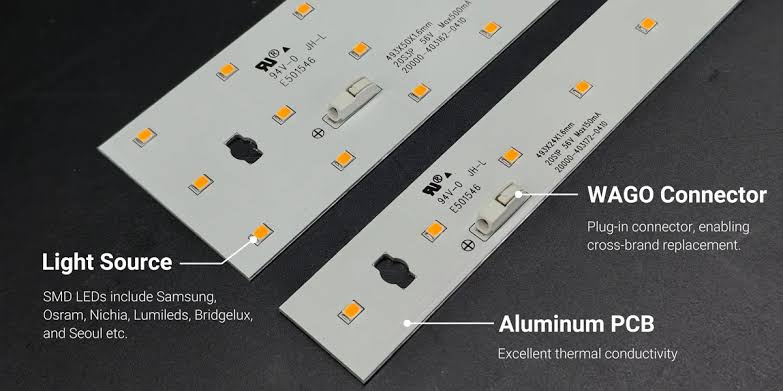
A linear light engine module distributes discrete surface-mount device (مصلحة الارصاد الجوية) المصابيح (such as 2835, 3030, أو 5630 الحزم) evenly across an elongated, rigid aluminum or FR4 printed circuit board (ثنائي الفينيل متعدد الكلور). Instead of concentrating lumen output into a single focal point, the linear configuration spreads light along a broad axis. Modern LED module manufacturers offer highly customizable linear boards with integrated push-in connectors (على سبيل المثال, WAGO or Molex terminals) for seamless end-to-end daisy-chaining across long architectural channels.
2. Technical Comparison: Linear Modules vs. COB Arrays
The table below contrasts linear light engine modules with traditional COB modules across key optical, thermal, and mechanical parameters:
| هندسة & Performance Metric | Linear Light Engine Module | COB (Chip-on-Board) الوحدة النمطية |
| Light Source Geometry | Extended linear array (strip PCB layout) | Concentrated single-point circular array |
| Luminous Density & Glare | Distributed low-glare output; soft area light | Very high lumen density; requires anti-glare optics |
| Optical Beam Control | Wide, uniform beam profiles (≈ 120° native) | Narrow to medium directional beams (15°–60° with lens) |
| Thermal Dissipation Profile | Spread across a large PCB surface, lower heat flux | Concentrated heat footprint; requires a heavy heat sink |
| Mechanical Integration | Modular; customizable length with push-in connectors | Fixed circular footprint; requires holder and reflector |
| Primary Fixture Types | Linear pendants, troffers, and architectural slots | Recessed downlights, track spotlights, and high bays |
3. When to Choose a Linear Light Engine Module
While COB modules dominate directional accent fixtures, أ linear light engine module is the clear technical choice for applications demanding shadow-free, continuous, and glare-controlled ambient light.
Linear LED Module Application Matrix for Modern Lighting Systems
Linear LED modules provide flexible lighting solutions for commercial, بيع بالتجزئة, museum, and architectural applications. Different environments require specific optical performance and structural designs to achieve consistent illumination quality.
| Application Scenario | Key Lighting Requirement | Recommended Module Advantage |
|---|---|---|
| Office Troffer Lighting | Requires uniform, low-glare illumination that meets UGR requirements. | Linear LED modules provide comfortable workplace lighting with balanced light distribution. |
| Retail Aisle Lighting | Needs continuous and shadow-free illumination across long display areas. | Custom LED modules create consistent brightness for enhanced product visibility. |
| Museum Wall Lighting | Requires soft indirect lighting without visible beam edges or harsh shadows. | Diffused optical designs deliver smooth light transitions for artwork displays. |
| Architectural Lighting | Requires compact PCB designs for slim aluminum profiles and customized fixtures. | Low-profile linear modules support flexible integration into modern lighting structures. |
By selecting the right linear LED module design, lighting manufacturers can optimize visual comfort, energy efficiency, and installation flexibility across different applications.
Commercial Office and Educational Facility Lighting
Modern workspace standards prioritize low Unified Glare Rating (UGR) targets to maintain visual comfort. Linear engine modules covered by opal or micro-prismatic diffusers produce even, shadowless illumination across task planes, making them the industry standard for recessed troffers, suspended linear pendants, and continuous slot lights.
High-End Retail and Museum Ambient Lighting
In environments requiring smooth, uninterrupted light lines, linear modules equipped with end-to-end interconnects eliminate dark spots at board junctions. Their wide native beam angle generates soft ambient washes that highlight wall textures without producing harsh, overlapping shadows.
Slim Profile Architectural Fixture Design
Due to their slender printed circuit board layouts (typically ranging from 10 mm to 40 mm in width), custom linear light engines slide easily into narrow aluminum extrusions. Their distributed thermal load allows luminaire manufacturers to utilize the aluminum housing as the primary heat sink, significantly reducing fixture weight and depth.
4. Sourcing and Customization Guidelines for Luminaire Manufacturers
Luminaire OEMs and lighting engineers can improve fixture performance by selecting the right LED module specifications. لذلك, manufacturers should evaluate LED quality, electrical compatibility, and thermal performance before production.
Select Consistent LED Binning and High CRI Performance
High-quality linear LED light engines require stable color consistency across multiple modules. لذلك, buyers should select LEDs with tight MacAdam Ellipse binning, such as 2-step or 3-step SDCM options.
High CRI LEDs with CRI ≥90 and R9 >50 provide more accurate color rendering. This feature is especially important for architectural lighting, retail spaces, and commercial environments.
Match Electrical Parameters with LED Drivers
Proper voltage and current matching improves LED module reliability and simplifies fixture assembly. Luminaire manufacturers should work with LED PCB suppliers to match forward voltage (Vf) and operating current with suitable constant-current LED drivers.
For extended linear lighting systems, series-connected modules can reduce wiring complexity and improve installation efficiency.
Choose High-Thermal-Conductivity MCPCB Materials
Thermal management directly affects LED lifespan and lumen maintenance. For high-output lighting fixtures, aluminum-core MCPCB substrates provide faster heat transfer from LED junctions.
Manufacturers should consider MCPCB materials with thermal conductivity ratings of ≥2.0 W/m·K. This design helps reduce thermal stress and supports long-term LED performance with L80B10 lifetimes exceeding 60,000 ساعات.
Linear LED Light Engine vs COB Module: How to Choose
The choice between a linear LED light engine and a COB LED module depends on the required lighting distribution.
COB modules provide concentrated high-intensity beams for applications such as spotlights and directional downlights. In contrast, linear LED light engines deliver wider illumination, lower glare, and more uniform light output.
لذلك, linear LED modules are ideal for architectural lighting, office fixtures, troffers, and continuous lighting systems. They provide flexible designs, efficient thermal management, and easy integration for modern luminaires.
TONGHANG designs وحدات ثنائي الفينيل متعدد الكلور LED مخصصة, linear light engines, and MCPCB solutions for global luminaire manufacturers. Our engineering team supports customized specifications to meet different optical, electrical, and mechanical requirements.
