

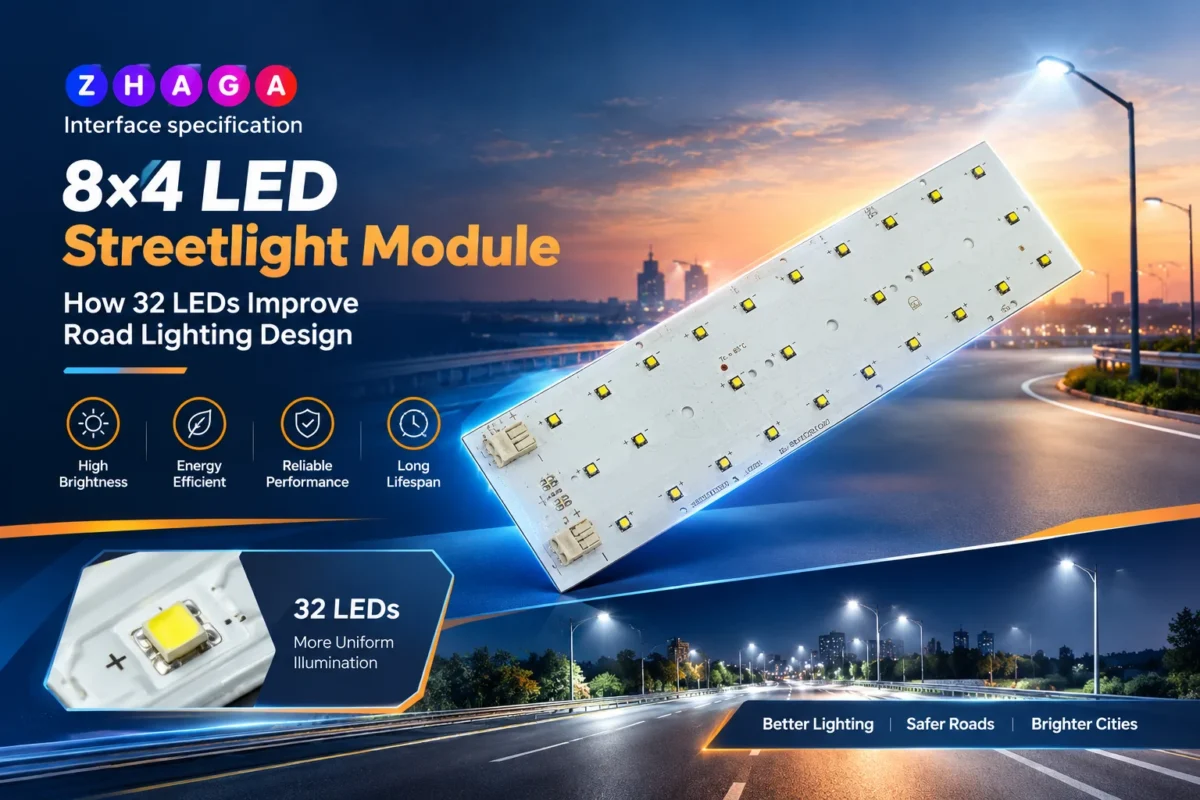
When evaluating an 8×4 LED streetlight module, wholesalers and lighting manufacturers should look beyond wattage and total lumen output. The LED arrangement on the PCB also affects optical performance, thermal distribution, and fixture integration.
A well-engineered 8×4 layout places 32 LEDs in a structured matrix. When combined with suitable secondary optics and thermal management, this configuration can help manufacturers develop reliable street lighting solutions for roads, parking areas, and other outdoor applications.
What Is an 8×4 LED Streetlight Module?
An 8×4 LED streetlight module uses 32 LEDs arranged in eight positions along one axis and four along the other. The exact orientation depends on the PCB design and how the module fits into the finished luminaire.
For example, a PCB measuring approximately 223 × 49.5 mm can accommodate a 32-LED matrix, depending on LED package size, spacing, electrical routing, and mounting requirements.
This layout provides a structured foundation for integrating LED packages, secondary lenses, and thermal components. However, the LED arrangement alone does not determine the final light distribution. Optical design and fixture geometry also play essential roles.
For streetlight manufacturers, the main objective is to achieve the required road coverage, lighting uniformity, and thermal performance within the available fixture space.
How Does an 8×4 LED Arrangement Affect Road Lighting?
The LED matrix influences how light sources align with the optical system. Proper spacing can support consistent lens integration and help engineers control light distribution across the target area.
Three design considerations matter most.
1. Light Distribution and Road Coverage
Street lighting requires more than high lumen output. It must distribute light appropriately across the road while controlling excessive brightness and unwanted light spill.
Secondary optics, such as total internal reflection (TIR) lenses or polycarbonate lenses, help shape the beam. Engineers select the optical system according to road width, pole spacing, mounting height, and applicable lighting requirements.
An 8×4 LED matrix can provide a useful arrangement for rectangular module designs. However, the final road coverage depends on the complete optical system rather than the LED count alone.
2. LED Spacing and Lighting Uniformity
LED spacing affects the physical arrangement of the light sources and their compatibility with secondary optics.
Excessively tight spacing may complicate lens integration and increase local thermal interactions. Excessively wide spacing may create challenges when the optical system cannot blend individual beams effectively.
The familiar zebra effect—alternating bright and dark areas along a road—depends on several factors, including luminaire spacing, beam distribution, mounting height, and road geometry.
Therefore, manufacturers should evaluate the complete luminaire through optical simulation or photometric testing instead of assuming that a specific LED matrix guarantees uniform lighting.
3. PCB Layout and Mechanical Integration
A structured 8×4 layout can simplify the positioning of LEDs and corresponding optical components. It can also help manufacturers coordinate PCB dimensions, fixing points, wiring paths, and the available space inside the fixture.
For OEM and ODM projects, engineers should confirm the PCB outline, LED coordinates, connector positions, mounting holes, and lens alignment before mass production.
These details help reduce integration problems when adapting an LED streetlight module to an existing housing or developing a new luminaire.
8×4 vs. 4×8 LED Layout: Which Is Better?
An 8×4 layout and a 4×8 layout both contain 32 LEDs. The main difference is how the LEDs are distributed along the two PCB axes.
Neither configuration is automatically better. The right choice depends on the module’s dimensions, optical design, installation orientation, and required light distribution.
| Design consideration | 8×4 layout | 4×8 layout |
|---|---|---|
| LED arrangement | Eight positions on one axis, four on the other | Four positions on one axis, eight on the other |
| Potential advantage | May suit a PCB with a wider LED distribution along one axis | May suit a PCB requiring a longer distribution along the other axis |
| Optical compatibility | Depends on lens alignment and beam design | Depends on lens alignment and beam design |
| Best selection method | Verify dimensions, photometric results, and fixture fit | Verify dimensions, photometric results, and fixture fit |
Before selecting a layout, lighting manufacturers should clarify which PCB axis aligns with the road width and which aligns with the road length. They should then verify the beam pattern through optical simulation or testing.
This approach is more reliable than choosing a configuration based only on its name.
How Many Lumens Can 32 Pieces of 5050 LEDs Produce?
A 32-LED module using 5050 LED packages may deliver approximately 3,000–5,000 lumens under certain operating conditions. This range is an illustrative estimate, not a guaranteed specification for every module.
Actual output depends on several variables:
- LED performance: Package specifications, LED binning, and operating temperature affect luminous flux.
- Drive current: Higher current can increase output, but it also increases power consumption and heat.
- Thermal management: Junction temperature influences light output, efficiency, and long-term performance.
- Optical losses: Secondary lenses and protective components can reduce the light leaving the fixture.
- Electrical design: Driver efficiency and operating conditions affect overall system performance.
Wholesalers should request measured module specifications rather than relying on LED count alone. Useful data includes input power, operating current, module luminous flux, efficacy, and test conditions.
For larger streetlight projects, manufacturers can combine multiple LED modules to meet the luminaire’s target output. The final configuration should also satisfy the project’s road-lighting requirements.
Thermal Management for a 32-LED Streetlight PCB
Thermal design is essential for an 8×4 LED streetlight module because LED performance depends partly on operating temperature.
A compact matrix must transfer heat away from each LED while maintaining a suitable temperature across the PCB and fixture.
Aluminum PCB and Thermal Paths
Aluminum-based PCBs are commonly used in LED lighting because they help transfer heat toward the supporting structure. The effectiveness of this process depends on the complete thermal stack, including the LED package, PCB dielectric layer, aluminum base, thermal interface material, and heat sink.
Thermal vias may be appropriate for certain PCB structures, but their quantity and placement depend on the board construction and LED package requirements. A design should not assume that every aluminum PCB needs six to twelve vias beneath each LED.
LED Spacing and Temperature Distribution
Even LED spacing can help engineers organize the thermal layout, but spacing alone does not guarantee uniform temperatures.
Engineers should evaluate heat generation, copper design, PCB thermal resistance, fixture airflow, and ambient temperature. Thermal simulation and temperature measurements can help identify hotspots before production.
For wholesalers sourcing custom LED modules, request thermal test data under clearly specified operating conditions. This provides a stronger basis for evaluating product reliability than visual inspection alone.
What Should Wholesalers Check When Sourcing an 8×4 LED Streetlight Module?
Selecting the right module requires more than confirming the LED arrangement. Buyers should evaluate electrical, optical, thermal, and mechanical compatibility.
1. PCB dimensions and mounting
Confirm the board outline, fixing holes, connector positions, and compatibility with the target fixture.
2. LED specifications
Check the LED package, manufacturer, binning requirements, drive current, and rated operating conditions.
3. Optical performance
Request photometric data or beam-distribution files where available. Confirm that the optical system suits the intended road geometry.
4. Thermal performance
Ask for thermal test results, operating-temperature limits, and information about the PCB and heat-transfer structure.
5. Customization capabilities
For OEM and ODM projects, confirm whether the supplier can customize PCB dimensions, LED spacing, electrical parameters, connectors, and optical integration.
6. Quality control and documentation
Review applicable electrical safety, environmental, and performance documentation based on the destination market and project requirements.
These checks help buyers compare suppliers on engineering capability and product suitability rather than headline specifications alone.
FAQ About 8×4 LED Streetlight Modules
What does 8×4 mean in an LED streetlight module?
It describes a matrix with eight LED positions along one axis and four along the other, for a total of 32 LEDs. The physical orientation depends on the PCB design.
Is an 8×4 LED layout better than a 4×8 layout?
Not necessarily. Both arrangements contain 32 LEDs. The better option depends on PCB dimensions, optical alignment, fixture orientation, and the required road-lighting distribution.
How many lumens can a 32-LED 5050 module produce?
Approximately 3,000–5,000 lumens may be possible under certain conditions. Actual output depends on the LED specifications, drive current, thermal performance, and optical losses. Buyers should confirm measured values with the manufacturer.
Does an 8×4 LED arrangement guarantee uniform road lighting?
No. The arrangement provides a physical layout, but road-lighting uniformity also depends on the optics, mounting height, pole spacing, and road geometry. Photometric testing is necessary to assess the finished luminaire.
Can an 8×4 LED streetlight module be customized?
Yes, depending on the manufacturer’s capabilities. Custom options may include PCB dimensions, LED spacing, electrical parameters, mounting details, and secondary optical integration.
Custom 8×4 LED Streetlight Modules from Tonghang LED Board
Tonghang LED Board designs and manufactures LED PCB modules for lighting manufacturers and B2B buyers. Our OEM and ODM services support customized LED arrangements, PCB dimensions, and secondary optical integration for streetlights, tunnel lights, and high-bay lighting applications.
Whether you are developing a new luminaire or adapting an existing fixture, our team can help assess module layout and integration requirements.
